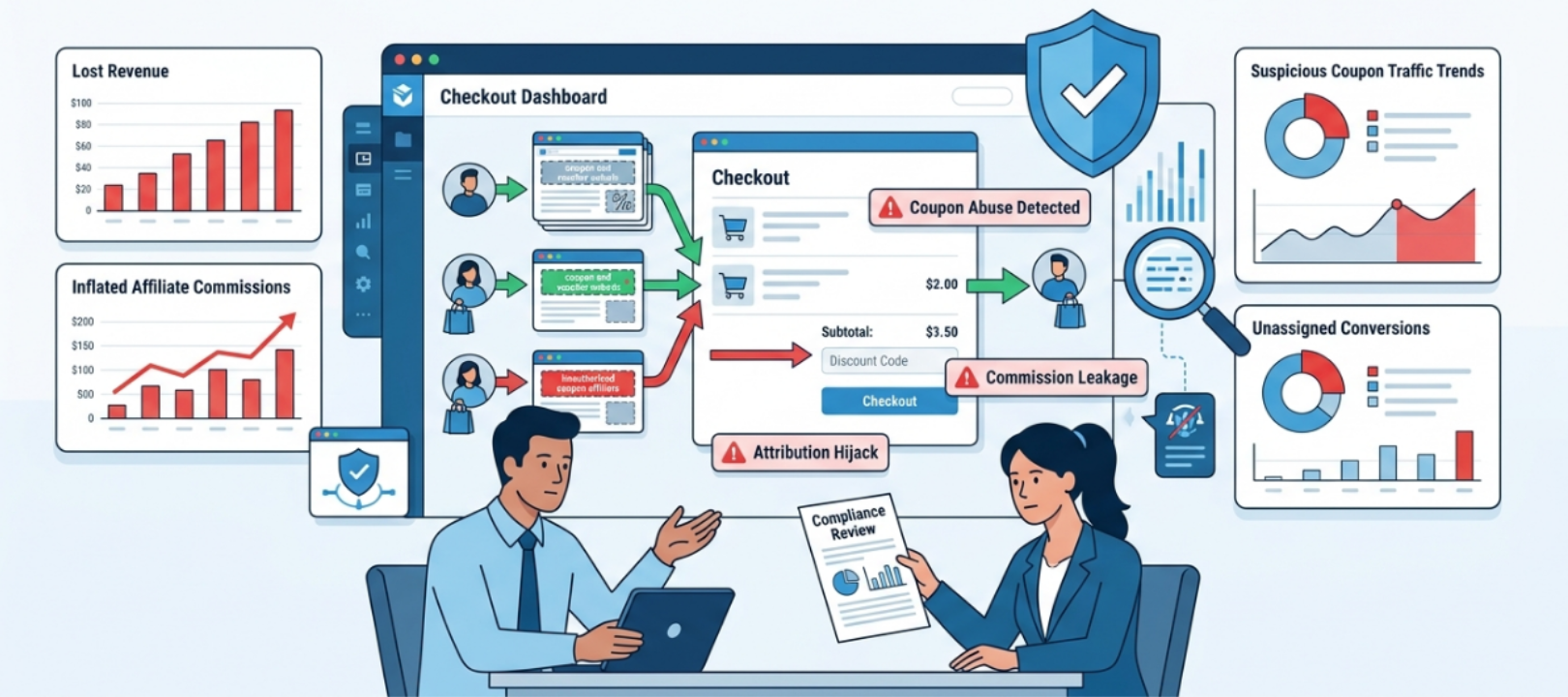
What if your affiliate program is leaking revenue at the final step of conversion?
Unauthorised coupon codes shared by affiliates and influencers or injected silently by browser extensions at checkout can override attribution and claim commissions your brand never intended to pay. This leads to distorted affiliate performance, rising acquisition costs, and margin loss on sales you already owned.
PPCTrace helps brands detect and prevent coupon and voucher abuse in real time by tracking leaked influencer codes, monitoring browser extension activity, and flagging suspicious discount behaviour before it impacts your payouts.
What is Coupon and Voucher Abuse?
Coupon and voucher abuse is a type of affiliate fraud where unauthorized discount codes or browser extensions intercept the checkout process, override the original referral source, and claim commissions on sales they did not generate.
It distorts affiliate attribution and results in brands paying commissions for conversions they did not actually acquire.
How Coupon and Voucher Abuse Appears in Real Affiliate Journeys
Coupon and voucher abuse appears at different stages of the affiliate journey, especially when customers are close to making a purchase. Influencer codes, coupon websites, and browser extensions can all intervene at checkout, quietly overriding the original referral source and shifting commissions away from the channel that actually drove the sale. Here’s how:
-
Influencer Code Leakage
Influencer codes like SARAH20 or MIKE15 appear on social platforms without direct brand authorization. Even when customers were already in the purchase funnel, these codes still capture last-click attribution and commission credit.
-
Coupon Aggregator Exposure
Coupon and voucher sites surface scraped or leaked discount codes during checkout journeys. Customers apply these codes at the last moment, shifting attribution away from the original referral source.
-
Browser Extension Injection
Browser extensions automatically apply hidden discounts at checkout, overriding existing attribution and replacing the original referral source.
This allows brands to identify revenue leakage patterns before commissions are finalized or payouts are processed.
The Hidden Cost of Coupon and Voucher Abuse
The hidden cost of coupon abuse detection refers to the losses businesses face when unauthorized discount codes and vouchers are misused in ways they were not intended for. It doesn’t always show up immediately in sales reports, but over time it affects revenue, affiliate performance, and business insights.
Here are some key industry facts based on various research papers:
- 43–53% of merchants say coupon, discount, and refund abuse is their most common type of fraud.
- More than $600 million is lost every year in the U.S. due to coupon fraud.
- 53% of merchants reported an increase in coupon abuse in the past year.
- Retailers lose over $100 billion annually to fraud, with coupon abuse being one of the main reasons.
PPCTrace helps advertisers identify coupon and voucher abuse by monitoring suspicious affiliate activity, tracking manipulation, and unauthorized coupon usage in real time.
How to Prevent Coupon Fraud in Affiliate Marketing
Coupon and voucher abuse is also commonly referred to as coupon fraud in affiliate marketing.
Coupon and voucher abuse is difficult to control manually, especially when multiple domains, affiliates, traffic sources, and promotional channels are involved. This is where having a proper fraud detection system becomes essential.
Affiliate fraud detection platform such as PPCTrace help brands identify, monitor, and prevent coupon and voucher abuse in real time, so businesses can protect their affiliate marketing performance before losses grow.
Here’s how a structured system like PPCTrace helps:
- Tracks exactly where affiliate revenue is leaking in real time across channels, ensuring accurate attribution and commission control.
- Detects unauthorized coupon and voucher abuse instantly by monitoring leaked codes, influencer activity, and abnormal redemption patterns.
- Flags affiliate fraud before commissions are paid out by identifying suspicious conversions and last-click attribution manipulation early.
- Identifies attribution shifts caused by browser extensions and coupon sites that override original referral sources at checkout.
- Shows real-time revenue leakage across affiliate channels by tracking conversion paths and comparing expected versus actual attribution.
- Reveals misattributed commissions instantly across campaigns by reconstructing customer journeys and validating true traffic sources.
- Centralizes fraud signals from the entire affiliate ecosystem into a single view for complete visibility and control.
- Protects every commission cycle with continuous monitoring that detects and coupon fraud prevention before payouts occur.
By combining these detection layers, PPCTrace helps brands reduce coupon fraud, protect affiliate commissions, and maintain accurate performance data.
Conclusion
Coupon and voucher abuse is not a rare exception. It is already happening inside affiliate programs across networks and quietly affecting every commission cycle.
It moves too quickly and is too widely distributed to be caught through manual tracking spreadsheets or periodic audits. By the time it is identified attribution has already been distorted and commissions have already been paid. This is why scalable automated detection is essential.
PPCTrace gives you real-time visibility into your affiliate program highlighting where attribution is being lost and where revenue leakage is occurring so you can understand the impact before it grows further.
Book a demo at PPCTrace now to see real-time attribution leakage across your affiliate network.