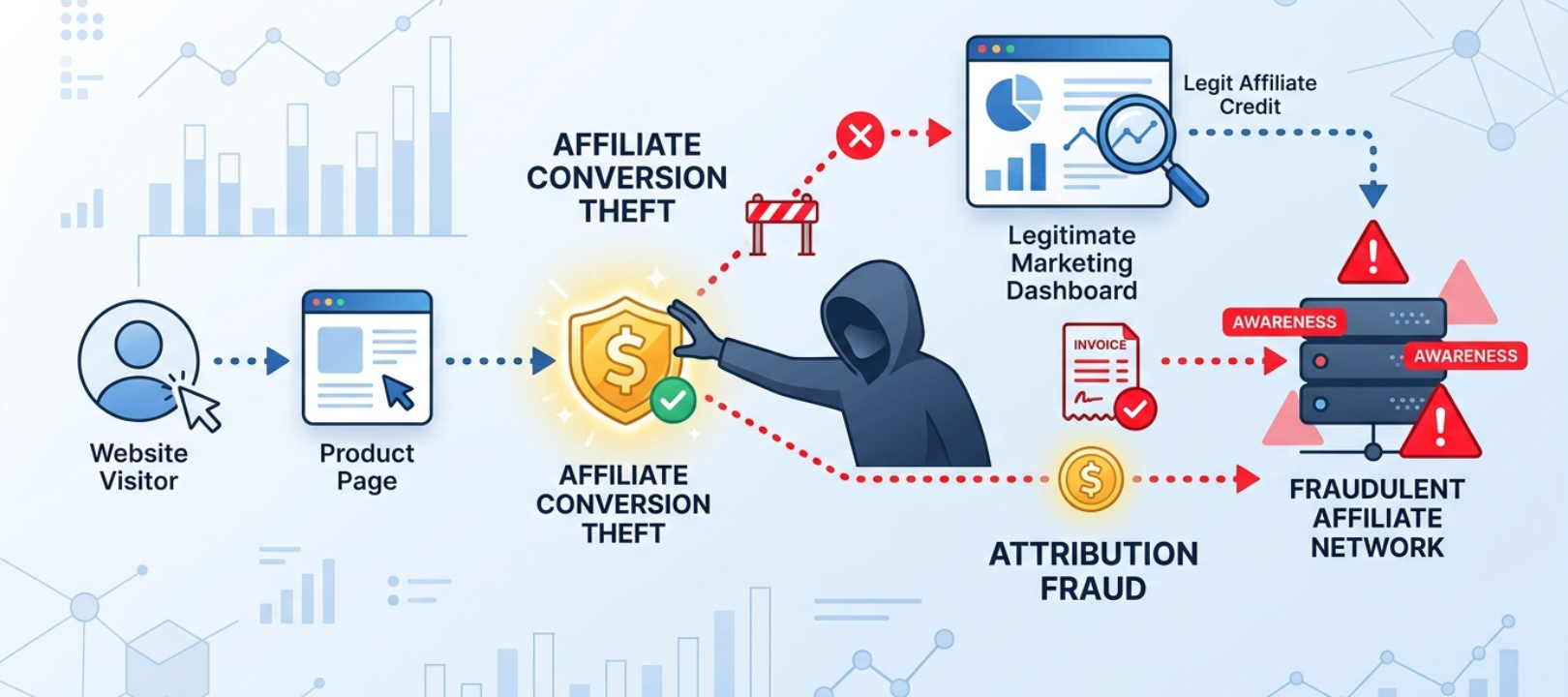
Affiliate marketing continues to be one of the most scalable and reliable performance channels for brands and advertisers. However, with its rapid growth, affiliate fraud has also become a major concern that directly disrupts campaign accuracy, affiliate marketing attribution, and overall profitability.
One of the most serious outcomes of this is affiliate fraud impact on ROAS, where return on ad spend appears inflated or misleading due to invalid conversions and manipulated traffic. In many cases, this leads to ROAS fraud, where performance metrics no longer reflect real customer behavior.
This blog by PPCTrace explains how affiliate fraud affects ROAS and distorts marketing attribution systems.
What Do You Mean By Affiliate Fraud?
Affiliate fraud refers to deceptive practices used to generate fake clicks, leads, or conversions in order to earn illegitimate commissions. These actions manipulate tracking systems and corrupt affiliate marketing attribution, making it appear that real users have converted when they have not. Here are some common affiliate fraud types:
|
Types |
Description |
Impact |
|
Cookie Stuffing |
Forcing tracking cookies without user permission |
False last-click attribution |
|
Click Spam |
Generating mass fake clicks via bots/scripts |
Inflated traffic metrics |
|
Conversion Fraud |
Fake leads or purchases |
Inflated ROAS |
|
Link Hijacking |
Stealing attribution from other channels |
Misallocated revenue |
|
Incentive Abuse |
Misleading users with rewards for fake actions |
Low-quality conversions |
These tactics significantly distort campaign performance and contribute directly to ad fraud ROAS inflation.
What is ROAS?
ROAS (Return on Ad Spend) measures revenue generated for every dollar spent on advertising. It is one of the most relied-upon KPIs in performance marketing. However, when ROAS fraud occurs due to affiliate manipulation, it creates a false sense of campaign success.
The Real Affiliate Fraud Impact on ROAS
The real case of affiliate fraud impact on ROAS is not just any common reporting issue but it directly affects the brand integrity and profitability.
Let’s take a look at the key impact:
- Inflated revenue numbers from unearned conversions.
- Overpayment to multiple fraudulent affiliates.
- Misleading or false optimization signals.
- Budget ad shifting away from high-quality standards & channels.
- Distorted ROI margins and calculations.
A 2024 benchmark study found that affiliate advertisers lose up to 17–25% of their ad spend to invalid traffic sources — with affiliate channels consistently among the most affected due to commission incentives. At that scale, a campaign reporting 4x ROAS may be delivering closer to 3x in real terms.
Types of Ad Fraud That Inflate ROAS
Ad fraud ROAS inflation generally comes from multiple deceptive fraud techniques that affect the brand trust and integrity. Here’s how:
- Ad Hijacking Detection: Identifying the illegitimate affiliates stealing brand organic traffic and real conversion credits.
- Brand Bidding Monitoring: Detecting affiliates bidding on branded keywords without permission.
- Coupon & Voucher Abuse: Preventing unauthorized discount code misuse and commission manipulation.
- Trademark Protection: Monitoring trademark violations affecting paid search campaigns.
- Browser Extension Abuse: Detecting malicious extensions injecting affiliate tracking cookies.
- Click Injection Detection: Identifying fraudulent clicks injected into the user journey that falsely claim credit before a genuine visit or conversion takes place.
Each of these methods easily manipulates the brand performance metrics, making advertisement campaigns appear more successful in SERP results.
Business Consequences of Affiliate Fraud
Affiliate fraud does not just impact analytics—it directly affects revenue efficiency.
|
Key Business Areas |
Impact |
|
Marketing Spend |
Wasted budget on invalid traffic |
|
CAC |
Artificial increase in acquisition cost |
|
Revenue Reporting |
Overestimated growth |
|
Affiliate Relationships |
Loss of trust with partners |
|
Decision Making |
Poor scaling decisions |
In many cases, companies continue scaling “high-performing” campaigns that are actually driven by fraud, resulting in long-term profitability loss.
The Attribution Problem: Why Fraud Is Harder to Spot Than It Looks
Affiliate marketing attribution assigns credit for a conversion to the last (or first) affiliate touchpoint in the customer journey. Fraudsters specifically exploit this mechanic — injecting themselves into the attribution path at the moment of highest value.
The result is attribution data that tells a completely false story:
- Organic search traffic gets stripped of its conversion credit.
- Paid brand campaigns appear less efficient than they actually are.
- High-performing legitimate affiliates are undervalued in commission tiers.
- Scaling decisions favour fraudulent traffic sources because they appear to convert best.
This is why fraud impact on attribution is often more damaging long-term than the direct commission loss. Brands end up defunding their best channels and scaling their worst ones — all based on data that looks clean.
The Role of Affiliate Fraud Detection Software
To correct attribution errors and prevent ad fraud ROAS inflation, brands rely on affiliate fraud detection software that filters invalid activity in real time.
Modern fraud detection software works across several layers:
- Real-time traffic monitoring to flag invalid sources before commissions are paid.
- Bot detection using behavioural signals — distinguishing automated traffic from genuine users.
- Click and conversion validation to verify that conversions reflect real customer actions.
- Affiliate scoring and risk profiling to identify high-risk partners before they scale.
- Automated fraud flagging with documented evidence for dispute resolution.
These systems help restore trust in performance data and improve overall marketing efficiency.
How PPCTrace Fraud Detection Software Helps
PPCTrace fraud detection Software is well-designed to reduce revenue leakage caused by invalid affiliate activities and improve attribution trust & accuracy.
Core Benefits:
- Detects fraudulent clicks and conversions in real time.
- Improves affiliate marketing attribution accuracy.
- Eliminates fake traffic influencing ROAS.
- Identifies suspicious affiliate behavior patterns.
- Enhances reporting transparency for advertisers.
By filtering out the invalid activity, PPCTrace ensures that reported ROAS reflects real customer behavior instead of tracking manipulated data.
Final Thoughts
Affiliate fraud continues to evolve, becoming more complicated and harder to detect in affiliate tracking systems. Its direct impacts on affiliate fraud impact on ROAS, ad fraud ROAS, and affiliate marketing attribution can severely distort marketing performance and brand decision-making solutions.
By implementing advanced affiliate fraud detection software and leveraging solutions from PPCTrace fraud detection Software, brands can easily ensure accurate attribution, protect ROAS, and build fraud-free affiliate marketing systems.